

In “Metta & Compassion Vibes,” Emily Horn explores the crucial difference between befriending difficulty through metta and the deeper, boundary-dissolving willingness of compassion to actually meet suffering — and why that meeting sometimes sounds like a fierce and loving no.
☸️ The Ten Pāramīs
You’re invited. to join Emily Horn in a practical exploration of The Ten Pāramīs: Ten Trainings for a Liberated Life this April.
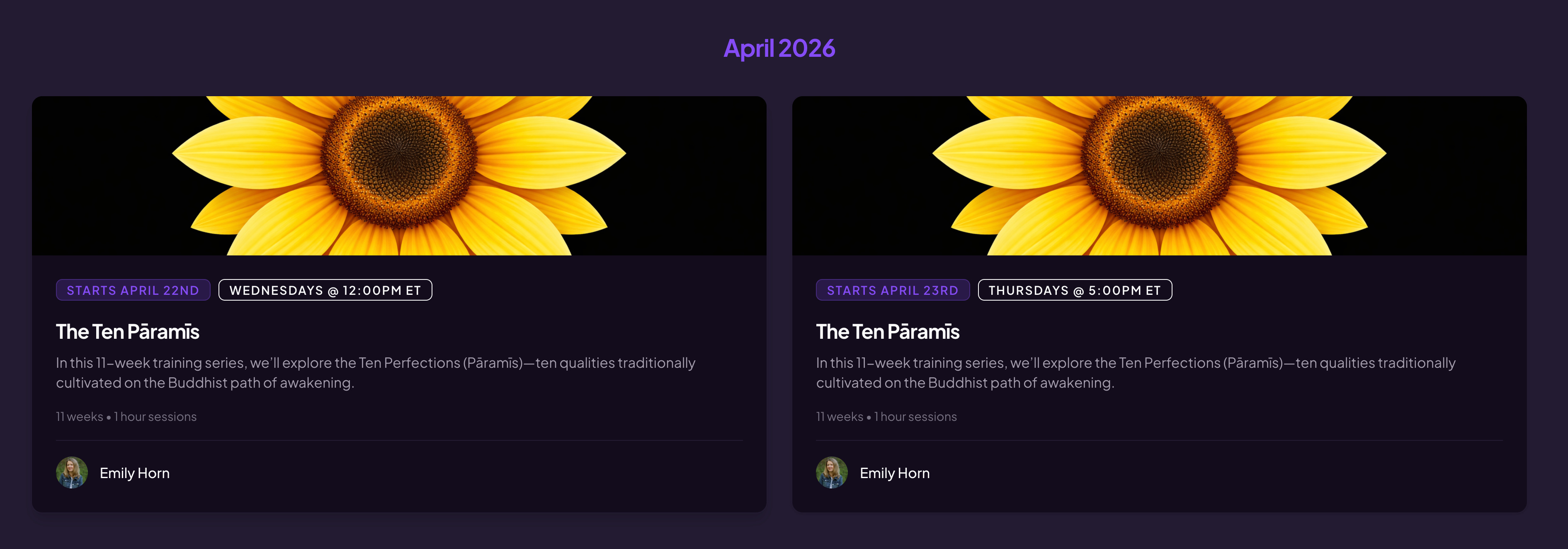
Become a member of the Pragmatic Dharma Sangha, and gain access to both live cohorts. Or you can join the kick-off session, on either of these dates, to see if it’s a good fit:
💬 Transcript
Emily: Sometimes when I sense into compassion, one of the things that comes up for me is this all-or-nothing kind of sense — where it is like compassion is here or it is not here — this binary kind of experience. All or nothing. I just want to invite that if it is here for us, it is like where I can have compassion for that person, but I cannot have it for myself.
That is another kind of all or nothing. So there are these different kinds of barriers — we could call them barriers to compassion — that start to arise when we incline. And we have been working with loving kindness. Metta, metta, metta, metta. So perhaps sense into inclining to metta for a moment.
Metta. Metta, this sense of befriending. And I have been sensing into that quality of befriending. It is a very difficult world. Humans are being everything on the spectrum to each other at this moment. There is a lot of cruelty.
And there is a lot of love.
So when I sense into metta, there is this sense of, okay, befriending even the cruelty. And that is a big ask. That is a big ask. And what does that even look like? Metta is a sense and a vibe — it is not a prescription for any kind of action, right, first of all. Now where compassion comes in for me, and where that inclination is important, is in the world and in our lives and in our relationships, and even with ourselves. We can have a sense of befriending, like welcoming. But then for me, it can get like, okay, I can befriend and welcome, but I am going to keep it over there. All right, I am going to keep it over there. I am going to keep you over there. I am even going to kind of see this sense of anger or agitation in myself, and I am going to kind of witness it. It is still going to kind of be over there in my experience — in here, over there.
Now as metta grows, that sense of boundary can dissolve. But here is where I want to bring in compassion, because to me, when I incline to compassion, you can sense into this. May compassion arise. There is this sense of boundary shift, so that whatever is painful, that has been — in the moment — befriended enough, just befriended enough to start to sense into compassion. Compassion is going to require me in a lot of ways to merge with that sense of pain, difficulty, even if it is just for a moment. There is a sense of meeting it, right?
With compassion, we meet suffering. And in some ways that sense of who is it that is really meeting it — we might not recognize it in the moment if it arises. Compassion in itself is a boundless state. It is not going to have a sense of boundary.
We might not recognize that until after. Okay? We might explore compassion in a way that requires us to remember with mindfulness what it was like to experience it. But compassion requires me to meet the suffering, whether it is arising internally, externally, and then sometimes it will shift where it is like both internal and external. All right.
These are the concepts that start to be used to describe this energetic — remember the vibe that we are sensing into as we explore these states. It is like, what is the vibe that comes with it? In the Pali language: metta, compassion, loving kindness. So the sense of befriending, and then this willingness — compassion asks us to meet it. To meet the suffering.
Now, it might be helpful to just remember: when we say suffering, what is it that we mean? What do I mean by suffering? All right, what is this? And there is so much of it, so many different flavors of it. With compassion, there is this genuine sense of — there is a willingness to see it. To meet it. Then even if it is conscious or not, a movement towards the alleviation of it. And that is really important. It is like the alleviation of it. And the alleviation of it might be in the form of a no. All right. So compassion might lead us into the action of no — no, we are not going to keep doing this because it keeps adding onto the suffering.
All right. Logically, sometimes it is a very simple thing to see. It is like, no, we are not going to hit people, because that hurts. And then what happens? That sense of compassion leads me into the alleviation of it. Sometimes this gets confused with empathy and I want to kind of put a sticky note on that.
What is the difference between empathy and compassion? Empathy — we human beings are very, whether or not we want to see this or even are attuned to seeing this, we are very connected biologically, neurologically. So empathy is that ability to sense other people’s feelings, to sense what is going on as a collective.
And yet empathy, if we are not aware of it and we do not sense it and know it as empathy, then sometimes we get confused and think it is compassion. But here is one of the differences: empathy can make us tired, right? Compassion — believe it or not — compassion is a boundless, energetic state. Right?
Firefighters, people that rescue for a living — they talk about running into burning buildings without even thinking. All right, it is like this natural kind of — for them, natural kind of response to run towards, to try to alleviate the suffering. And they might not even realize it is compassion in that moment, right?
Because the sense of boundaries dissolves. That is one of the ways that it gets confusing. It is because compassion arises, there is not this sense of me and you. And yet it is really difficult sometimes to sense into where that sense of blocking happens when we start to expand into the universal mind state, heart state of it. I can sense into certain kinds of difficult people where it is like, no, not them. And for me, what is really supportive is to say, okay, yeah, with metta — metta is a boundless state as well. Everything is held in it. And with compassion there is that sense of alleviation of suffering that also can hold a no. So we can — in some ways our cognitive mind might have to be reprogrammed a little bit as to what we think this has to look like, because a lot of times that is where the confusion comes in.
There can be a fierce quality of compassion that can still hold everything in the universe and at the same time say, okay, in this human, personal world, we are going to stand for the embodiment of love and say no to that which is not right, to that which is not. And that can look a lot of different ways.
And we are seeing that more and more and more. We are seeing more and more of that no, collectively, against the kind of cruelty that compassion asks us to meet. And it is a really, really big ask.
One of the challenges with compassion — just in the heart states in general — and remember, part of the way this is traditionally laid out in the Buddhist framework, especially with the metta practices and the insight meditation tradition, it is like we start with loving kindness to kind of get that sense and get our sea legs with befriending even some of the difficulty that we do not even want to in ourselves. We kind of get our sea legs, and then we are like, okay, compassion — let us take it slow and steady, but learn how to digest the closeness, the intimacy, the connection that can be an acquired taste. Through that realization of, oh yeah, we are so connected — that for me, unless I have been able to digest that suffering a little bit at a time, then the next heart capacity that we learn to cultivate, or find our way into cultivating, is equanimity. All right?
And that is the non-preference for pleasure and pain. But with compassion, it is like we get our sea legs learning how to work with suffering, right? Learning how to — okay, so what am I not going to get out of? Sickness, old age, and death is what the tradition says.
And then what can I start to actively roll up my sleeves and say, okay, no — and slowly, slowly change? Sometimes that rate of change is a lot slower than I personally want it to be, and that is part of the rub with compassion — is that we have to kind of rumble with it, because it is not really up to me.
And yet at the same time, this both-and comes online where the capacity grows for holding: oh yeah, it is not really just up to me. There is something a lot bigger here, and yet it is not just up to that. There is this non-dual dance that comes online as we grow more and more into being able to hold equanimity. And then joy will come in there.
So I present it — that seems like a very linear process, but for me it is more like a learning how to kind of access these states and acquire a taste for them, and then also learn where it gets sticky, because the sense of identity starts to — like we talked about last time — the sandpaper, it starts to rub in a way that kind of creates the sandpapery friction.
Now, compassion incline — that is what starts to make that rub, that sandpaper. It starts to smooth it, smooth it out, whether we like it or not, which deepens our capacity for equanimity. So they all relate to each other. It is just that we will start to kind of bump up against, so to speak, energetically, the vibes that appear to cause us to lose access to this. Yeah. Slow and steady. Slow and steady.
We are going to incline now. I would like to lead a practice to kind of get a sense for this in another way. Part of what I have learned with this sense of the metta and the compassion — there is a practice called RAIN. And some of you have done that many times. Some of you love it, some of you hate it, some of you, whatever.
But I am going to teach it again today. It is: Recognize, Accept, Investigate — and I am going to teach it like Tara Brach teaches it, which is Nurture, which is the N. That has a lot to do with that compassion and loving kindness shift. The reason that I am teaching it right now, as we transition with that loving kindness and compassion, is because you may have noticed this already with the heart landscape: part of what we are getting our sea legs with — and some of you have them already, but some of us are still learning — is the emotions. All right. Emotions, feelings — it can cause the waters to get choppy. And in some ways, one of you mentioned numbing. With compassion, it is like, yeah, RAIN can help us steady and use mindfulness practice so that we can scaffold into heart states in a way where it is not so jarring.
Practice with us: We learn more, when we learn together. If you want to learn together with experienced teachers & driven peers, we’re welcoming new members to the Pragmatic Dharma Sangha.
Work with me: Apps, books, or group teachings can open the door, but lasting transformation and healing requires personal guidance. Together, we can navigate the difficulties of daily life—whether you’re leading a team, nurturing a family, or simply seeking steadiness and clarity in uncertain times. Learn more about how I approach Individual Sessions.


