



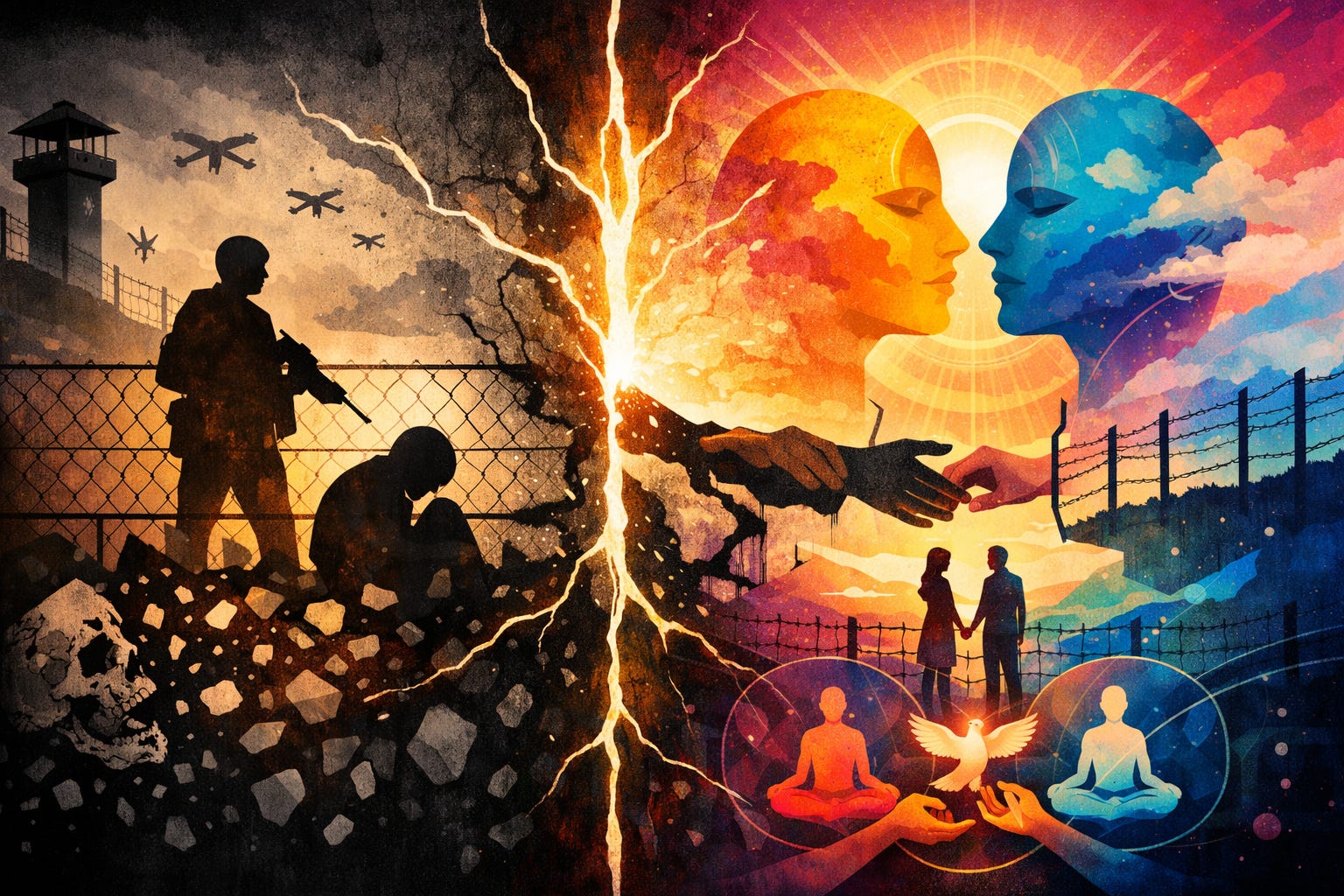
In “The Cost of Truth,” Vince Fakhoury Horn speaks with Daniel Klein—a former religious Zionist settler turned outspoken critic of the ideology—about dehumanization, self-forgiveness, and the courage required to speak truth at the risk of losing everything (except one’s humanity).
💬 Transcript
Vince Fakhoury Horn: All right, Daniel, I got my tea ready. Okay, so we can dive in.
Daniel Klein: One of my last drugs is coffee.
Vince: I’ve heard often that the Buddhist drug of choice is tea, and it makes sense if you look at the history of people doping up on tea before sesshins and long sits. Clearly it’s a stimulant.
Daniel: If you approach it with enough intention too, I’m sure some of the dens in China with the right master can take you quite far.
Vince: Oh yeah. They call it gongfu for a reason.
Vince: Well, Daniel, it’s great to be here with you. I’ve been looking forward to this conversation since we connected last week and had a get-to-know-you chat. And before that I met your work through Substack and your voice and your perspective on things. I definitely encourage people to check you out there if they’re listening from Buddhist Geeks to get the full breadth and depth of what you’re talking about. But I appreciate you being willing to have this conversation with me about what is one of the hardest topics right now to talk about, period. Like globally, it seems like it’s one of the most charged things that one can discuss, as I found with my teachers recently, and as I’m sure you found on your side of the conversations. Does that seem accurate, to assess it that way? It’s a difficult conversation.
Daniel: Yeah. I mean, for me, it’s a conversation that’s been almost 35 years in the making, ever since I was born. And it probably took another 10 years of really arduous work to get to a point where we can have the conversation, though I do think it’s getting easier as time goes by. It’s kind of a muscle, having these really challenging conversations.
Vince: That’s a good point. Difficult conversations are like practice. I appreciate you having this with me. Maybe I could give my ridiculously oversimplified version of my understanding of your story and then you could actually correct me and tell the real story.
Daniel: It probably can’t be wrong and I would love to hear it reflected back at me.
Vince: Well, I know very little, but the little that I’ve garnered and the reason I was excited to chat with you here in the context of this series of conversations I’ve been having on the Buddhist Geeks podcast, Meditating on Palestine. My understanding of your background, your history — it’s so unique. You came up in the West Bank in a settler community as an Israeli. You grew up with a family and a community that was completely embedded in Zionist Israeli culture. And specifically, there’s a difference, as I understand it, between the settler culture and the more urban culture, far off from where things are happening. Maybe I’m not sure if that’s true, but it is here in the US. Urban and rural cultures tend to be different. So you grew up in what I would think of as a place where most people are not going to engage in deep self-reflection about their relationship to their own country’s actions. Especially when they’ve learned their whole life that this is totally reasonable, justified defense. My understanding is that at a young age you started to question some of these things and eventually that culminated in you fully kind of breaking from your own community and your own family in some sense, and your religion. I think at some point, I’m not sure how the religion falls into that. I know you had a shift in your relationship to religion as well. I mean, otherwise you probably wouldn’t be practicing dharma.
Daniel: I would say it was a reconnection, is probably more accurate.
Vince: Great. Well, sometimes a reconnection can look like, from a conventional standpoint, completely leaving something. But in reality you’re like, oh no, this is what it’s really about. I totally get that. So here’s the crazy thing. When we talked last, you told me that you left Israel a month before October 7th, 2023. And you felt that something was building and that you did not want to be there anymore. So that brings us up to present day. You’re living in the US now. And you are married or engaged?
Daniel: I’m engaged to Christina. I’ve been married in the past. That’s part of the journey. That’s part of the story.
Vince: Part of your story as well.
Daniel: Part of the self-reckoning. I think everything that you said is really accurate and there are so many layers to it, from the urban to the rural, because on some level, Zionism is certainly not a monolith. However, there is a systemic architecture to it that applies across all spectrums. So the Zionist ideology will meet lots of people where they’re at. There’s the secular flavor, there’s the religious settler flavor. Is it divine, is it secular? All of these different things can all be true at once. But what you were saying is accurate. So I was born and raised in a religious Zionist West Bank settlement. These are the spearhead of the ideology of the settlements. And I really, for me, I say that this was a journey of how I came to see the Palestinians as humans. That’s what I really think is the arc of the journey. And in order to get to the place where I could see them as humans, I first had to discover my own humanity.
And as I understand it, the basis of everything that we’re seeing is dehumanization, is the othering of another person, which starts at a very, very young age with very deep conditioning and programming. And the thing is that it really can start from things as simple as the regular childhood trauma that we all experience. Something as simple as you can’t marry outside of the tribe, and how do these seeds of beliefs over time create a situation in which we can see the other as non-human?
Vince: Yes. I agree with you that dehumanization is the root issue here and that’s why I’m happy to have this conversation as well, because as you know about my history, my grandfather was a refugee of the Nakba. So he came to the US through Egypt and his family continued to live in the West Bank until the 1980s. So they were connected to this area, and your family is from this area. It’s like, how else could two people with these histories be talking if we weren’t able to meet each other as human beings?
You know, I think that’s the case here. I see your writing and I see your work and I see it’s deeply human. And it’s not just that I agree with you on theoretical points about the challenges that Palestinians face with respect to Zionism and Israel and unequal power, occupation, et cetera. I think we see largely eye to eye, but it’s your humanness and how you’re sharing that, that for me is what’s most interesting about it. It’s not just like, oh, there’s a person who ideologically I’m in agreement with.
And I guess I want to highlight that. To me, this is important. Your story is a human story, like you said. How did you encounter your own humanity? I’m sure there are many moments, but what was the big one with respect to this?
Daniel: I recently wrote an article called “Breaking the 10 Commandments.” And that was really the breaking point for me. So I married young, I was married at 20.
Vince: Okay.
Daniel: And about five years into that relationship, there was a window of time where I was unfaithful to my partner. And back then I was still very much in a state of unawareness, going through the motions. I was allowing myself to kind of be controlled. You’re just moving through all of it. And I had this moment of reckoning at some point where I had to take a deep breath and I look back in total shock, realizing what had just happened. And I kept this a secret for seven, eight years.
And that was really a time where I was sitting with just the first part of the reckoning, which was: first of all, how did this happen? How could this have happened to me? I’m such a good person. I’m so moral. I say the right things. I do the right things. Everything looks so perfect on the outside.
Vince: Right?
Daniel: I’m the golden child. All of these things. And somehow I did one of the worst things in the world, one of the Big 10. And I had to sit with that. And at first I was trying to figure out how could I bury it? How could I explain it away? How could I take a big enough dose of psychedelics and hopefully not return to planet Earth? There were nights where I was praying, just praying for death, because the thought of having to face this and the shame of what I’d done. And all the while I am continuing to play the part, while I’m completely being destroyed on the inside.
Vince: So at this point, you’re still acting like a faithful husband and like you’re the golden child.
Daniel: I’m the golden child, and my spiritual journey is still progressing. Right. These things are not actually exclusive. We can hold many compartments and we can evolve in some ways, and we can be held back in other ways.
So I’m trying to figure things out. I’m going through this journey, and ultimately I came to this realization that if I could do this, there is nothing that anybody else can’t do, because I knew what my center was. And so if I was capable of this, there’s nothing that anybody else isn’t capable of. And in that moment, that’s when I realized, okay, I’m human. But that was really only the beginning of the journey, because it’s not just about recognizing it, it’s actually about going through the work of trying to repair.
And so I came forward and realized that I needed to tell my wife the truth. And so I came forward with the intention of moving into deeper levels of union, trust, vulnerability — putting it all on the line, and here I am naked. And so it was from that place where all of a sudden my entire identity, ego, image — everything kind of collapsed in a moment.
And in that place I had to go on the journey of self-forgiveness ultimately, and figuring out how do you make sense of people doing bad things, but ultimately how do we find forgiveness for them? So for me, there was this parallel journey, the inner world and the outer world reflecting one another.
And I could always see how this journey of truth and accountability was connected to what I was going through. And I had to go through this process before I could make space to realize what we’re doing collectively, having walked through the fire of truth and knowing that the cost of truth could be everything. It could be the woman you love. It could be your money, your image, everything.
Vince: We don’t know when we take that step.
Daniel: We don’t know. But that’s really the fear, right? We all live in this fear of, well, what will be the cost? And very often the cost of the pain that we’re sitting with is not as great as the cost of the truth. So we’ll continue to be in pain until we can’t anymore. So that was the journey in a nutshell of finding my own humanity, recognizing that there’s nothing that anybody can’t do. And it was through this journey where I could see this in myself that I was able to start seeing it in the outside world as well. Once you see something in you, you can recognize it in others too.
Vince: Right. So that sort of opened up your perception to include some of the things that you hadn’t been seeing prior to that, or been able to see.
Daniel: Yeah. And just to take a step back, I was deeply indoctrinated into the ideology and I held all of the classic Zionist beliefs. There’s no such thing as a Palestinian people. A land without a people for a people without a land. I believed that it would be better to just push the button and have everybody just disappear. And that could be holy, because the world that I come from is also very messianic. So there’s the divine aspect of, how could this war be a holy war? How could this actually be a good thing for humanity, to rid humanity of this problem? And we were sent and we were ordained to follow through with this mission.
Vince: Right.
Daniel: There’s a long journey to go from that to come out.
Vince: Yeah. Deeply. I mean, you’re talking about your whole religious infrastructure, your core beliefs about reality and your place in it.
Daniel: And my experience from that was actually that the true religion is Zionism and Judaism is merely a branch of Zionism. And as I was starting to go down this journey, I had resistance to the classic establishment of Judaic religion, the rabbinic religion. And I had departed from that actually from a very young age, when I was four or five years old. I was already not doing the things when people weren’t looking. That didn’t really quite sit with me. But the Zionist belief, that remained long. That was more
Vince: foundational.
Daniel: Yeah. That remained long after the religious aspect.
Vince: How do you distinguish those two? Because that’s where a lot of pain and suffering seems to arise, around the conflation of these two. It sounds like you were able to untangle something.
Daniel: To untangle these things. Yeah. When you’re on the other side of it, it almost seems simple. One is a political ideology that needed a myth, that needed a people, that needed somebody in order to perpetuate itself. All ideologies need vehicles, all ideas need hosts. And in this case, this political ideology found a really receptive host that not only had a very powerful national myth, but also had an immense amount of collective trauma that could be weaponized. And these two things just completely fused together.
For me, Judaism as a religion is one thing. And deeper, there are deeper aspects in the Jewish religion, which would be like the Hebrew channel. Beneath the religion is the source. And at some point I was able to connect to the inner aspect of the religion, the deeper layers beneath the religion, the esoteric, connecting to the source. And once that happened, the compatibility with Zionism as a political ideology is completely shattered. One is a way to connect with oneself, and the other is a way to dominate another.
Vince: Which are very different things. You know, just to shine the light backwards here, I certainly know what you’re talking about from the point of view of being an American. The American myth is very clear to those who’ve woken up from it. American exceptionalism is the way it’s described. We are the best in the world, and we’ve got all this track record of being the best at overthrowing the tyranny of the British Empire, and then we’re the best at extending it.
Daniel: So how do you see the connection between these two things or these two ideas? Because for me, it’s less about pro this or anti that, but rather how do we go beyond? Because on all sides of all aisles, we have people that other. And ultimately, if we’re gonna meet in a place of healing and meet in the present moment, we have to be able to move beyond these aspects and meet. So I’m curious. When you talk about American exceptionalism and how you perceive it, where are the seeds of what we’re talking about here, or how you feel it?
Vince: Yes. Well, the way I see them and feel them in America is like, we clearly have been an imperial-ish power, a modern empire, and we’ve had this dominance economically, militarily, such that we were calling this the unipolar world for a while where America’s the only power that’s significant or matters. Now, obviously we’re at the end of that. That’s part of a lot of the geopolitical tension — the multipolar world is reemerging. But I grew up in a unipolar America where I was taught and fed this myth. We came and liberated the Jews from the Holocaust, which is just historically not the reason we actually got into the war. And we tell ourselves a story about how we didn’t use the nuclear bomb on anyone else other than the first two cities we annihilated. So we were like, we could have taken over the world and we didn’t, you know, there’s these stories about America. I’m not saying they’re all untrue — there are some true moments of nobility there and sort of universal wisdom probably. But also, we use those moments to justify dominating the globe. And so I grew up just feeling like I’m entitled to that domination. But at the same time, I was also a Palestinian, so I knew the other side of it, which is like, I’m being dominated by it. And look what happens.
Daniel: I’d love to hear a little bit also about your experience and your grandfather’s experience and how that journey brought us here today to be able to have this kind of conversation.
Vince: Yeah. Well, he was an adapter. Latif was very much an adapter and he was an achiever. He was all about doing well in school and making sure he could provide for his family when he came to the US. That classic immigrant mentality fueled by deep, unresolved trauma, fueling his attempt to be successful. That was him in a nutshell. He’s more than that, but that was the main driver that I saw growing up. He really did adapt to American culture. We didn’t speak Arabic growing up, although a lot of my family members did. He abandoned the Islamic tradition when he first came here to make it easier to not be targeted. And he did everything he could to make sure his identity wouldn’t become a reason that would prevent him from being successful.
And so he made a lot of compromises and left a lot behind. In some sense, out of necessity, he abandoned his cultural tradition, which is really sad in retrospect, because this is a culture that’s in a sense being erased and ethnically cleansed. He kind of went with that. And it’s understandable, to adapt. So that’s where I come in. Two generations later, and I’m like, oh, adapting is really important and I know how to do that. I’m really good at that. That’s why Buddhist Geeks, I think, was a success — because I knew how to adapt across different systems and tease out connections that were seemingly disparate. That was from the experience of being a Palestinian in American society. You have to bridge these big gaps. But for me it’s been a process of coming back and retrieving the things that were left behind.
And saying, no, actually I’m not just going to continue to adapt. There’s a point where you’re adapting too much. So much so that he was a Trump voter during the last 10 years of his life. And this is a very tolerant dude, historically. It made no sense to me whatsoever that he was supporting Trump. And I realized after a number of years of arguing with him and contemplating why — this was his survival strategy. Get on the side of the people that have the most likelihood of actually causing you harm so that you’re not gonna be harmed. And in a way, to Palestinians who are on the other side of this equation, that’s a total betrayal, right? It’s like, dude, you’ve abandoned your identity and your people just so you can survive and take care of your family.
And so in that sense, I think I want to rectify that — that he wasn’t able to stand up for people because he was so scared of being harmed again, of losing everything again. And that’s understandable, but it’s also not okay. We have to be willing to risk, as you said — to say the truth. We have to risk not knowing what could happen to us or to our loved ones, to actually stand out on a limb morally. It’s very risky. So my taking these risks now is a direct result of wanting to do what he wasn’t able to.
Daniel: I was about to say that it’s really beautiful how you can now look back and see how his choices were affected by the things that happened to him and his desire to avoid being in that pain again.
Vince: Yes. Which — I get that and I’m sure it’s the same thing that’s driving what’s happening right now in Israel and Gaza. It’s the same underlying thing. People don’t want to feel pain and so they would much rather transfer it unto others. Create more pain. Or avoid it. Ignore it. And it really hurts to not exercise your voice on behalf of those you care for.
Daniel: The system in many ways creates conditions that force people to have to think about their safety, their physical safety, their emotional safety in order to protect themselves. And one of the things that I had discovered at some point was that Israel uses its power of controlling people’s movements in order to coerce them into participating on Israel’s behalf. If somebody wants to get a visa, if somebody wants to get a permit, there might be conditions that come along with it. And the systems, and the fear that comes with not only the fear but the programming that forces people to willingly or consciously or unconsciously cooperate with these systems, is deeply profound. And it transfers generation after generation.
Vince: Absolutely. It makes so much sense, because going back to what you were saying — when you realize there’s nothing people can’t do — to me that’s so true. To be human is to be able to dehumanize others. I think about adult development: where do people start? They start by forming an ego. They form a sense of themselves. I believe that when infants are first preegoic, they’re just fused. There’s no sense of identity apart from whatever’s happening. And it’s not enlightenment. They don’t know. It just is. And then we build a sense of self and then there’s an inside and there’s everything else outside. And everything outside is just to serve our internal experience and needs. Give me more food, I’m gonna scream. Well, that’s egocentrism. That’s where we all start.
And then we’re expected to grow out of that and at least begin to center the needs of our immediate family and the people that we care about, and eventually our whole culture, our community. That’s ethnocentrism. When you can identify with the whole, and that’s a development. But ethnocentric people don’t dehumanize the people they’re closest to anymore, like an infant will. An infant doesn’t care. I mean, I’m telling you, I’ve had one. They sometimes do, they love you and they care, but they’re really egocentric. So like, my son now, he’s 10, he’s starting to develop this ethnocentrism where he does care about his impact on others.
But then, if people just stop there and they don’t go to the worldcentric or beyond stages of development, where they start to include all people, or even the whole earth as the sphere of identity of who they find themselves to be — this is all coming from my experience with Ken Wilber, the integral philosopher. He talked about development as a process that transcends and includes previous stages. So even though we go beyond egocentric, we never transcend it completely. We still get hangry and we regress. Or if someone calls us a name on social media and we become an asshole and we’re egocentric again, we’re dehumanizing the other. We do this all the time. I don’t understand how people don’t think that we’re always dehumanizing each other.
What I find interesting — I’d be curious how you feel about this, Daniel — one of the major reactions that I struggle with to this situation, both in Israel and Gaza but also here with ICE in the US, is this idea of like, oh my gosh, I can’t believe we’re dehumanizing other people, that we’re letting this happen again. And it’s like, well, it never stopped. You are doing it every day. I’m doing it every day, to more or less degrees. It’s on a bigger scale and it’s to an important degree, so that’s why we’re talking about it. But let’s not pretend that we’re beyond this. We’re not.
Daniel: Well, it’s all a reflection. That’s been my experience, right? I take the yoga of the reflection very seriously. And at some point, earlier in my journey, when I started seeing what was happening on the outside, I was very angry at first. I was very afraid at first. I was very afraid when I started recognizing that — the way I understood it was, back in 2020, I wrote in my diary for the first time: Israel is a police state. I live in a police state. And that was a long process to put it in writing, because you think it before you write it and then you write it before you say it. And then you say it before you put it on Substack for everyone in the world to see it. So there’s a process.
And yeah, I was scared at first, and then I was angry. And then in the realization that, oh my God, look at all the horrible things that I do. Look at the way that I treat people. Look at the way I treat myself. Of course, that’s what the world looks like. I’m contributing to this. This isn’t separate from me. This system is a hundred percent built on me. Or, I’m not sure if it would be in the Buddhist understanding of the matrix, right? But capital Y, you are the thing.
And so that allows us to certainly deescalate internally, but to take a deep breath and first realize, okay, this is all inside of me. And from that place, we can start approaching it from non-reactivity, right? The way out is not to get angry and the way out is not to punish one another. And the way out is certainly not to repeat the cycle, because right now we’re in a moment where we have the ability to break the cycle.
And right now I believe that one of the gifts that Zionism is giving the world is the full view of a completion of a cycle. What does it look like when a victim becomes a perpetrator? Why is the victim and the perpetrator locked into a dance? They both need each other. And this is the polarity. They always go together. And right now we have this unique moment in time where we can take a step back, see it for what it is, and then extend the forgiveness that allows us to actually break the cycle. Otherwise, we’re just doomed to repeat it.
Vince: I’m sure you’re familiar with the Karpman Drama Triangle — the victim, persecutor, rescuer. Anyway, just wanted to highlight that.
Daniel: Yeah, we’re always stepping into it, and we’re always wearing one of the hats. And this is part of my reconnection to the sources. At some point I was recognizing, at least from my experience, first it was with the Torah, but then I started recognizing it in all of the sacred texts — that they’re all mirrors of the self. You’re looking at a map of you.
And so if you look at the Torah and you see a character in the Torah and you presume that it’s something that’s separate from you, you’re now caught in projecting. Pharaoh is in you at any point in history because it’s timeless. There’s no time and space in Torah. That’s one of the axioms of Torah. It’s not a linear book. And so you can always find yourself at any moment in time acting out any of the archetypal components of it, because it’s all transpiring now. And that’s what I realized — the fact that we’re in Israel doesn’t make us the Israelites. You can be Pharaoh and wear a yarmulke. There’s no connection between these things. It’s one story. And if you separate these two things and then get caught in projection, you’re gonna become the Amalek — the mythical enemy of the Jewish people — where we can now invoke Amalek every time we want to completely destroy someone, and then not recognize that that’s our own capacity for destruction and atrocity.
And I see so much of this issue being developmental for that reason, because I see the same characteristic of every culture, human culture, that’s either ethnocentric as its center of gravity, or which in response to stress or trauma has regressed to an ethnocentric place.
Vince: Which is like, there is the complete capacity to include everyone who’s part of the group in a loving embrace and to completely dehumanize anyone outside of that group who threatens it. To the point where you could theoretically annihilate them all — that would be the most extreme version of dehumanization. But it can be anywhere from ignoring people and not caring that they have an interior experience too, to wanting to get rid of them.
So I think, to me, if that is actually a developmental stage of human maturation and we can’t get rid of it and it’s always going to be with us, how the hell do we live in this world with the knowledge that there’s something much wiser possible? That seems to be the real challenge.
Daniel: Well, how do we connect to something bigger than ourselves? I think that there’s a moment of higher ground where you connect to something bigger and there’s no turning back. At some point you get a glimpse of the unity, you get a glimpse of what’s possible in your own inner world. And you find the inner peace, and once you have the experience of that, it becomes fundamentally unshakeable.
Vince: In the moment of experiencing it, I would agree.
Daniel: Well, I say it’s kind of like a turtle. I think that there are levels. There’s a moment in which you kind of pop out and you get a glimpse. The veil is lifted. We call it stream entry in Buddhist theory, or kensho. And then one of the first reactions to that could be: whoa. I’m gonna kind of put my head back in and come back. I think that at some point there’s a big enough breakthrough where you become so big that you can’t actually even fit back in the hole. And you go in, you go out, but then at some point, you know what there is. And obviously on the day-to-day, you keep going and you fall, you get up, you fall, you feel it, you go into the ego. But there’s a point at which you see the possibility and you relentlessly work towards creating it here.
And I’m actually curious, because you were talking about the ethnocentric tribe — you’re in and you’re out. And there’s something here, because from my experience, I was in the tribe. And being in the tribe means that — I’m actually not sure what it means at this point. This is maybe my current exploration. But I’m Jewish, or I’m Zionist. But ever since I spoke out, I’ve been completely shunned and tossed out and excommunicated and rejected. And so what’s happening here is that the ideology actually trumps
Vince: kinship.
Daniel: Kinship. Exactly.
Vince: Yep. That’s how Jordan Hall defines civil war, by the way. One of my favorite philosophers. When ideology trumps kinship, that’s civil war.
Daniel: Yes. And for me, that’s been actually one of the most painful parts of the journey — reckoning with that experience and that feeling and that pain of being rejected and abandoned, because these are the deepest childhood wounds. That’s what kept me in place all of these years in the first place — precisely this fear, the fear of how the community will excommunicate you if you choose to break the silence.
Vince: Which is not unfounded, obviously. It’s not an unfounded or irrational fear at all.
Daniel: On many levels. On the social media level, it’s the insults, the name-calling, the sexual degradation. There’s a lot of sexual projection. But maybe I haven’t mentioned it though — a really beautiful part of this whole journey, going through this reckoning both personally and collectively, is how I met my beautiful, wise, kind, loving partner Christina, who is Lebanese Armenian.
And so she comes from the other side of the border. And if we’re talking about the reflection, the ability to really do the healing to the point where love is love across borders, across time, across stories, across lineages, across tribes — that’s where the real work is, to be able to recognize the person on the other side of the fence. And in her family, her dad’s family lost all of their property on the other side of the border. They had homes literally on the other side of the security fence. They’ve all been leveled.
Vince: Wow.
Daniel: So they’ve been on the other side of this entire experience. And I’ll get a lot of hate for that. And all of the words that are associated with a Jewish person marrying outside the tribe. You see the
Vince: ethnocentrism in the other tribe.
Daniel: Exactly. So it can be really, really harsh. And I think that idea of ideology trumping kinship is very, very powerful.
Vince: Yeah, it is. I could see that with, in the US we’ve been in that situation culturally for the last decade or so at least, where it’s been very heightened. And that’s the main reason I was unwilling to cut off relationship with any family members, because I’m not gonna allow this ideological stuff to get in the way of the core relationships.
Daniel: Family.
Vince: Yeah. Family.
Daniel: I was thinking about this the other day where I was imagining, okay, what would it be like to be on the other side? What would one of my siblings need to do or believe or say in order for me to do that? And I realized that I could be angry at someone. It’s not that you don’t need to feel things. I’m angry at you, I’m disappointed in you. I think you’re doing bad things. You’re my sibling. I love you.
Vince: Right. Yeah, totally. This is an area where the progressive pluralistic left side of culture has a massive shadow, I think. Which is like, I’m not going to include you if you don’t share my vision and view about inclusion. Okay, how is that not another form of ethnocentrism also?
Daniel: It’s a form of colonialism. It’s a form of domination and exclusion and
Vince: othering. Yes. And it’s understandable. It’s coming out of that sense of being victimized again. The easiest thing to become as a persecutor is someone who’s been victimized. And it’s not saying that population hasn’t experienced legit victimization. It’s just to say I can see how all of these different camps in the culture war — the progressive camp, the modern rational camp, the traditional ethnocentric camp — these different camps are at war with each other.
And one of the things I’m appreciating here is — I got this phrasing from a business executive coach named Rand Stagen, who runs an integral leadership academy in Texas. He’s talking about how we have to go beyond finding common ground. Common ground is good, but we’re actually looking for higher ground. And higher ground is a pursuit. It’s not something someone has that other people don’t. It’s a pursuit that we’re all engaged in together. It’s an emergent something that can happen. And it only happens when we hold the truth of these different perspectives.
And to me it’s like, if you collapse into ideology, if I sort of become a progressive, which happens, and then I’m like, everyone who’s not this is not human,
Daniel: I’m not gonna treat them as such. I always make fun of the Buddhists that say I am a Buddhist. And I’m like, are you?
Vince: Right? If you are a Buddhist, then you’re maybe not a Buddhist. But also if you’re not a Buddhist, you’re also not a Buddhist. If you can’t both negate and preserve —
Daniel: though, we do have to have some form of way to communicate.
Vince: Right. Well, that’s the only thing we have, so we have to do that.
Daniel: Yeah. I think when you talk about higher ground, it’s a really beautiful and important idea, and the challenge is being able to even see the higher ground, because when ideology is fused with ego — I think that’s a huge part of the mechanism here — when the ideology becomes fused with the ego, you need to go through surgery, right? How do I actually disentangle these beliefs from who I am? And that process actually feels like death. That is the process of dying while you’re still alive because you’re completely dismantling
Vince: your ego, which is your sense of who you are.
Daniel: Exactly. And so when it’s so fused, the process is so painful to admit these things. The shame is so great. The pain is so great at looking at these things and owning them. The thing is that until you do that, you can’t see the higher ground. So one of the things that I’d like to share with people is that the experience of reality that I have now is not something that I could describe in words. I can’t say this is the higher ground because it’s an experience. It’s only through the process of looking at truth, looking at yourself and dismantling, that you can even become aware of what this higher ground is and how we can meet in that space. But it can’t be described to somebody. It has to be experienced. And either you choose to do it at some point or it is going to be done to you, and the longer you wait, the more painful it becomes.
Vince: Yeah. Part of how I can sense the higher ground that you’re inhabiting around this — usually, I’m not saying always, because higher ground is something we have to hold — it’s like the middle way. What I see there is I don’t see you dehumanizing your family or your friends or your country. I see you taking a very strong stance, and I see you arguing against the ideology, but I don’t see you necessarily saying the people who are captured by the ideology are evil.
Daniel: No, because it was me.
Vince: Right. Well, you could do that though. You could absolutely demonize yourself.
Daniel: Yeah. But that’s the journey here — the journey of self-forgiveness. And what I want to be able to hold in this conversation is precisely that. Because it was me. I can understand that it is not uniquely evil. That’s really important. It might be evil, but it is not uniquely evil and it is certainly not outside of my own capacity.
Vince: Right.
Daniel: It was me and I had to find the forgiveness for myself. And it’s my family. I love them. It’s my people. They’re humans, people, family. I love all of them.
Vince: And to be fair to you, you were born into a karmic stream.
Daniel: And so are they. And so are their parents. And if you kind of take the karmic step back and you see how it’s playing out and how each one of us is playing our part — I’m processing what I’m processing. They’re processing what they’re processing. And we need to let things unfold. Because you can’t force other people. You can bring the horse to the water.
Vince: Yeah.
Daniel: I found that the more that I tried to argue, the more damage I was doing to myself.
Vince: Right. So it’s like, if you’re trying to force someone to see a higher synthesis that you have discovered through a process of ego death, essentially — it’s not gonna be so simple for them to see that. Just like it wasn’t for me, it wouldn’t have made any sense. And you had to have a lot of motivation. A lot of things build up to get you to that point. And then it’s about sharing truth. You can be strong in sharing it. You can be centered in sharing it. And then the chips fall from there.
So I understand, and I assume that you’re still in communication with people in Israel — friends, family, some people who are willing to be with you.
Daniel: Yeah.
Vince: So that’s a good indicator that you’re engaged in this process. I mean, to be honest with you, I found it very hard to be in conversation with any people who are Zionist in their orientation right now. Even though I theoretically want to be.
Daniel: It’s so important to do it. And again, it was me. So it’s almost like I know how to navigate it and I know how to hold it in many ways.
Vince: Sure. It’s different.
Daniel: And honestly, what I’m finding is that with time, it’s easy for me to be in connection, but the people that don’t want to be in connection will just pull away. They won’t really engage. The texts that go unanswered — people will pull away. But there are people that are willing to engage because I do see the seeds of awakening. And this is also kind of an exponential function, right? So it might feel slow at first, but as we move along, this process is gonna speed up.
I see the seeds of it awakening, and I see the people that are following what I’m writing. They’re taking it in. And for them, I think it might be the first time that somebody so close to them, who they perceived as something so binary, has taken this position. And I know that people are watching, I know that people are listening, and I understand the psychological mechanisms by which people either distance, explain away, bypass, don’t look at. And it really ties into their nervous systems too, right? This is also all a journey of the nervous system, and there’s really only so much that these nervous systems can handle. Everybody is at a different stage.
So actually I have a friend who is a brilliant man and he can a hundred percent hold my perspective. And yet he is diametrically on the other side of this, which is most fascinating.
Vince: Can he hold your perspective cognitively or is it full spectrum? Is he holding it emotionally and in an embodied way as well?
Daniel: He’s holding it in an embodied way.
Vince: Oh really? Okay.
Daniel: So it’s actually fascinating because he’s very deep into it. Ideologically he’s deep into the religious side, so he’d see this as an absolute holy war. I’ll share this because I think it’s actually really important — how we could distort a concept like unity or one body. I was told by this friend once that, you know, I told him that we’re all created in God’s image and he said, absolutely, we are all one body, but some of us are the head and some of us are the excrement. And in this case we’re the head and the Palestinians are the excrement.
Vince: You’re the shitty part of God. Basically.
Daniel: You’re the shitty part of God. And I’m the holy part of God.
Vince: The head is holy.
Daniel: Exactly. And yet this is somebody who actually is in conversation with me and is embodied in holding this perspective. And so there’s a spectrum of readiness, awareness, groundedness that different people, I think, are starting to look at and engage.
Vince: Yeah. There’s the people and then there’s the people in power. And those are obviously often different things, but they’re not disconnected sometimes. People decide that they’re fed up of things that people in power do. So that seems like a good sign. It doesn’t relieve immediate —
Daniel: No, because I was gonna say that it’s a good sign, but I actually don’t want to downplay the fact that the true genocidal mania, as I perceive it, is not fringe. It is very much mainstream.
Vince: I think that’s something a lot of people have a hard time understanding or believing, especially Americans.
Daniel: Yes. And from my experience, having been very deep in it, it is so much — one of the things that I’m actually writing about now is that the extent of it and the depths of it is actually deeper than people are aware of. Even people that are anti-Zionist, or pro-Palestinian, do not understand the extent of how bad it is. In terms of the beliefs that regular people will hold, and this could not have been possible if there is not enough of a deep mainstream — because this is 75 years, 85, even longer, a hundred years, hundreds of years of rooting in the making. And it’s even hard to describe what the life of a Palestinian really looks like. And first of all, how disconnected the average Israeli is from understanding what it looks like to live under the Israeli regime day-to-day.
Vince: But that’s something you were more exposed to, being the tip-of-the-spear community, right?
Daniel: Yeah. Growing up, we lived in a settlement. It was the most quaint, suburban, biblical hilltop that we were living on. Parks, lush. It’s beautiful. We’re doing our thing and we’re living in a sea of, you know, back then the framing would be Arabs. There’s us in our bubble. We have the guard cars and the fences and you don’t really think about it because you’re in the quaint existence.
But then you go out and you see — for me, many of the formative moments would be driving from my home in the West Bank into Jerusalem or going towards Tel Aviv. And I would drive through the checkpoints that over the years I saw went from being small little outposts into these tremendous border crossings. And I started to notice and see with my own eyes how Palestinians would get to the checkpoint early in the morning. They would line up at four o’clock in the morning to get to the other side of the fence to get a job. And I would see them subjected to these horrendous conditions where they’re moving like cattle through these fences. And I would look at it and say, these people are being herded like animals. Show me your papers. Show me your papers. Show me your papers. And at some point, just the cognitive dissonance — it looks the same.
Vince: It sounds the same. The rhyming is scary.
Daniel: I see the pillboxes looking over with the guy with the gun asking for your papers as the people are herded through fences. And then I started to see how they’re using biometrics on them. The idea being that before anybody can even have a free thought, they’re captured. And the depths of how bad it is, I think, escapes Israelis and it escapes many people. And it takes such a deep, fervent, systemic dehumanization and level of denial that it’s pretty hard to describe.
Vince: And I think it’s uniquely hard for Americans to see because they have such a similar story in so many ways. There’s this resonance of like, we are persecuted, we fled here, we started our thing, and we’re self-determining — there’s just so many parallels. And we live in a police state too. I remember I was telling you, I read Isabel Wilkerson’s book “Caste,” which is a really great look at caste throughout history. And one of the things she pointed out is in Hitler’s cabinet, there were more progressive Nazis. Like, you have a wide range of ideological views even within. It’s not a monolith. The progressives at the time — there’s a proposal put forward to fashion Nazi Germany’s racial structure around the American system. And the progressive Nazis were like, whoa, whoa, whoa. That’s too much.
Americans like to think we are morally superior in all ways, but no, actually we’ve been horrid in some ways, and we’ve been able to get away with it in part because we don’t look at it. And anytime Black people say, hey, look what you’ve been doing, people freak the fuck out and then elect Trump.
Daniel: Right. And then they come for you.
Vince: Yeah. Imperial boomerang, right? That’s how the story always goes.
Daniel: It always comes back. I think that’s very true about America. It’s the same mechanisms of denial and shame and what we would need to acknowledge living the existence that we live here in order to take a step back and meet in that place of higher ground. And then America obviously perpetuates the whole thing.
Vince: We support it. We enable. We are in the victim, persecutor, rescuer triangle.
Daniel: Well, you hand over the gun for somebody else to shoot. It’s a mechanism.
Vince: I think of it more as the enabler also. The problem I have with the Karpman Drama Triangle is the real issue is the victim-persecutor dynamic. It’s like almost a war between these two roles. And the rescuer is supposed to rescue the victim, but the persecutor also has support — those are the enablers.
And I think the problem with the Karpman Drama Triangle is it’s framed for the individual and it assumes that we move between these roles, which is true, and that we’re not objectively a victim or objectively a persecutor. But if you zoom out and look at history, some people are more victimized or persecuted than others. Relatively speaking. Then this model becomes a little bit more useful to recognize, like, the US is enabling. There’s a lot of western states and countries that have enabled this. Why? Because they’re too close to their own colonial history. They still don’t see that those things are operant in our governments and in our ways of perceiving. We don’t understand that the decolonization movement is actually right.
And the second someone hears this that doesn’t agree with me, I know they’re gonna bristle and maybe turn off the podcast. So to your point, it’s not always helpful to point this out. But you and I are having a frank conversation here. So somebody read one of my posts, “Freedom from Zionism,” and their response was that I should be in prison.
Daniel: Which prison?
Vince: You could be either US or Israel, just to be a little cynical at this point.
Daniel: Yeah. And so there’s almost nothing that one can say, or level of repentance and healing or evolving that one can do, that there isn’t somebody who’s gonna be like, you should be in prison. Or worse. So there’s always somebody who’s gonna turn off the podcast.
Vince: Yeah. Absolutely. Are you familiar with the Empowerment Dynamic, or TED? There’s another model that relates to the drama triangle. It’s also used in the business world a lot in coaching. But the idea is that each one of these roles, you can transmute into a more empowered version. So the victim actually becomes a creator. In that model, the opposite of victim is someone who feels like they have creative agency.
And the persecutor can become a challenger. So the wise energy of persecution, when it’s made wise and mature, is to challenge — not to try to destroy, but just to challenge. And then the rescuer becomes a coach in the empowered version. They actually help by asking questions and helping you, instead of trying to assume you’re a victim and hold you in that position. They try to empower you to be a creator.
Daniel: Oh, I love that. Rather than save you, they help you save yourself.
Vince: Yeah. So I think that model, I like it because it points to creative, literally creative solutions and creative roles that one could be practicing inhabiting. And I do try to do that. Even with this stuff where it’s like, okay, I notice the tendency to be in the victim role. I notice the tendency to then switch into persecution. And I want to work with that so that I’m not perpetuating these patterns in myself and through my relations.
Daniel: I’d love to hear from you a little bit about your journey of sharing these truths, sharing your experience, how that’s received, how you’re experiencing it professionally, personally.
Vince: Yeah. So for a long while I experienced this in a compartmentalized way, where I would share publicly about these things, for instance, but just on Twitter. And I wouldn’t share in other domains because it’s like LinkedIn — that’s an obvious one.
Daniel: Right. That’s a minefield.
Vince: Right, exactly. And even on Buddhist Geeks, I didn’t really get into it, which was one of the main channels that I had available to me. So for a long time it was compartmentalized. It wasn’t until the last year or so that I realized I have to speak up. It’s very hard to speak up. That’s part of the Palestinian karma — this fear of using your voice, because then you’re gonna stand out. And so I wrestled with that fear for a long while, and sort of compartmentalizing dealt with it. But then finally I was like, I need to be whole in my position here and consistent everywhere I show up around this. Because it’s that important. And so what if it’s scary.
Daniel: So what was that moment where it was like, this is too much?
Vince: For me it was really around my teachers, Jack and Trudy. I wrote about this in a Substack post: “Is the Insight Tradition Complicit in Genocide?” And the TLDR was like, yeah, I think so. And that led to a rift with my teachers because they agreed with me that it was a genocide. They’ve consistently supported social justice movements in the past. And then the fact that they weren’t able to on this — it was so clear to me. Okay, well, even if you’re Jack Cornfield. Even if you’re Trudy Goodman. You’ve been practicing for almost your entire life. You’ve been engaging with these practices. Even for them, there are these edges, these places where they can’t go themselves.
And so I realized, oh, I have to be more courageous than my teachers. In a way, on this. And that means calling them out, unfortunately, after sort of calling them in for quite a while. And giving them opportunity and space to rectify the things that need rectifying.
Daniel: And how is this received?
Vince: So on the one hand, the fears totally came to pass — I haven’t heard from Jack or Trudy since, and I doubt I will. Who knows? So I’ve been sort of cut off. And at the same time, I found my people — people who are supporting the Palestinian cause in the dharma world. That post actually ended up being like a lighthouse for finding those people. And that was unexpected and very good. Because I had recently been exiting an online community called Tpot, this part of Twitter, which I was increasingly finding to be kind of postmodern neofascist, very hostile toward Palestinians. And I was super disillusioned. And so to find this community at that moment felt like — to your point earlier — oh, I had no idea what would happen when I did that. But I certainly wasn’t thinking that I’d get more support. Actually, I thought it would be the opposite. So good thing.
Daniel: That’s a beautiful takeaway. For people to know that, because I think that part of what I hope people see or experience from my journey is that ultimately all of your fears will come to pass. And not only is it gonna be okay, but everything that you were actually looking for, that you were really yearning for, lies on the other end of it. So you will survive and thrive on the other end of it. And all the right people will come, all the right opportunities will come. All the right love is gonna come if you take those courageous steps.
Vince: Yeah. And people in reality do seem to respond to genuine acts of courage and bravery. It’s rare. And so people who know it can recognize it. The signal’s clear. So that’s what also surprised me.
Daniel: I think your story with the establishment when it comes to religion is really fascinating and really important, because that thread is gonna continue everywhere where people start to challenge the — in the New Testament it would be called Pharisee consciousness. But Pharisee consciousness exists in every institutional religion where all the middlemen, any rabbinic authority, the traditional authority, is gonna start to see this complete breakdown. And I’m curious your thoughts on the Buddhist establishment as an establishment versus your personal connection to it. What are your feelings about the institutional aspect of the practice?
Vince: Yeah. What comes to mind is how I view lineage is multifaceted. There’s the institutional lineage, which is what you’re talking about — the organizations, the governance, all the external systems that comprise the thing. But then there’s the relational lineage as well, the person-to-person communication and contact. And then finally there’s the direct lineage or the experience — your first-person experience of the lineage. And I think all of those are actually part of lineage. They’re all legitimate dimensions of lineage. But they’re not always in alignment.
Like, I remember the story of Suzuki Roshi — the famous Zen master, author of “Zen Mind, Beginner’s Mind” — who moved from Japan to the US. He left his son in charge of the monastery, who apparently had almost no formal training. It was just a completely nepotistic relational lineage. Like, let me put you in charge.
Daniel: How’d it work out?
Vince: I don’t know. I don’t remember the end of that story.
Daniel: Well, we’re living the end of the story today.
Vince: I’ll have to go back and look. Sometimes it works out to leave the kid in charge and other times not.
But to me, yeah, the institutional lineage of American Western Convert Buddhism — people who’ve converted or have included Buddhism as part of their identity but were probably raised in a Christian culture — the institution really struggles when it comes to this issue and this topic. There are obvious contradictions being laid bare and real problems. In terms of the relational lineage, I think it’s similar — these things are causing ruptures in relationship. Ideology over kinship.
And I wonder what that experience is like on the first-person side. I remember talking to Trudy, and the thing that stands out for me is when I pushed her on this, her response really was, I don’t want to be pushed to be more of an activist than I am. And I’m like, wow. I see you as an activist and you present yourself as an activist. It just seems consistent that you’d be an activist across all these things. But here I am holding this assumption. She’s not going to be living the universal embodiment of the teachings that I’ve heard from her. And I don’t either, always. So why would I be expecting her to? Unless I’m projecting Buddhahood inappropriately.
Daniel: Well, teacher wounds, guru wounds. A great teacher is one that recognizes that eventually you’re going to be disillusioned from them.
Vince: Absolutely.
Daniel: Because if you don’t become disillusioned from your teacher, you’ve completely missed the point that you’re the teacher.
Vince: Yeah. But as a teacher, I sure hope it’s not because I didn’t speak up about a genocide that I had a big influence over.
Daniel: Well, when you zoom out, if that’s the lesson that you eventually need in order to integrate where you are now — that’s the lesson.
Vince: Fair enough. And then the teachers are on their own journey too.
Daniel: Yeah.
Vince: They are. And I think that journey is tied up in the Jewish trauma of the Holocaust as well. I see that. And I, to some degree, feel compassion toward that because I actually understand it. So it’s there. I wish we could meet there with compassion. And that’s one part of it. I do feel that. But on the other part, I feel compassion toward Palestinians. And this shouldn’t negate that. For a long time I was letting my compassion toward their pain negate my compassion toward Palestinian pain. Or somehow that was more important. And part of it was more important because I was concerned about how it would affect me personally. So this is cowardice, essentially.
And so the challenge here is like, how do you maintain compassion that is ruthlessly willing to stop harm from being caused, and compassion that embraces and understands the pain people are feeling, is patient and generous toward that? As people have been toward me in my life. This is a real paradox to me.
Daniel: It’s huge. You were suppressing your own feelings and your own pain, your resentment, in order to accommodate somebody else’s.
Vince: Exactly. That’s right. Exactly what my grandfather did, which I understand.
Daniel: And then we’re in this situation where the genocide is moving along the phases. The phases are public and progressing. People are suffering and dying. And we’re afraid. There’s the aspect of being afraid of hurting other people’s feelings.
Vince: Right. Exactly. Which is so ridiculous on the surface of it.
Daniel: And that’s part of the mechanism too, right? As if the Jewish uniqueness, the unique victimhood, the unique pain. And my partner comes from the Armenian lineage and the Armenian genocide. Growing up in Israel where the Holocaust was the unique pain, you have a hard time seeing outside of it. But this idea that we shouldn’t speak our truth for fear of hurting other people’s feelings — and then the paradox becomes, it’s not about being cruel to other people, but at the same time the genocide is moving along. So how do you hold these two things of standing in truth, not justifying, not making it okay, and recognizing that this is actually happening — while being respectful? How do you really hold that center?
Vince: Yeah.
Daniel: I think that you do a really beautiful job of it.
Vince: Yeah. And I guess I would say, as someone who identifies more as an aversive-type personality — I’ll be the person that will cut through things and become irritated really quickly — I’ve had to learn that there’s a lot of wisdom in that, to not just demonize that style. The wisdom of clear seeing, when it’s expressed, can often be critical and cutting. And the thing I know about the teachers I’ve been critical and cutting toward is that they’re capable of that same capacity and they’ve used it in loving ways toward me. So in that sense, I feel like I’m doing them a favor by returning that favor. It’s like, hey, I’m sorry that you can’t see this right now, that you’re in too much pain or that you feel like you’d be risking too much to take this position. But here, I’m gonna offer you this as a reflection: you’re not living the teachings that you’re teaching.
And for sure, I expect fully that being disillusioned by your teachers and seeing their limits is part of the maturation process for every student.
Daniel: It’s because it’s gonna happen to us too.
Vince: It’ll happen to us. Yes. It’s already happened to me. I’ve been teaching long enough that I’ve already seen it.
Daniel: Yeah. I mean, it happens all the time. It’s a daily practice. And I think that a real part of the practice here, when it comes to these blind spots, is when you’re in connection with people. Obviously every person outside of you is able to see things in you that you can’t see. This is just a law of reality — they can see your blind spots.
Vince: They’ve got the outside perspective.
Daniel: And they’re holding a key that you can’t see. And you need to be able to let your ego down to allow them to just say it. And when you’re on the giving side of this, if you want to speak the truth — and I actually struggle with this too, because I’ll kind of say it as I see it, and then the other person very often will have a reaction. And then I’ll find myself having a reaction to their reaction rather than being able to allow them to process or meet their nervous systems where they’re at. But if you’re gonna dish it, it’s really important to be able to receive this too.
Vince: To receive, yeah. Agreed. This is maybe a subtle nuance, but I can see in my own personality a little more resistance to taking in feedback. And I think it has to do with being in this minority identity perspective, where the Palestinian part of me has constantly been subjected to the whims and wishes of the dominant culture. And so to be open to feedback sometimes assumes peership. I think you can’t have honest feedback if there’s a power differential. Someone can’t give feedback to their boss without fear of it affecting their job.
Daniel: Yeah, absolutely. That’s not a safe container for somebody to be able to share.
Vince: Yeah. And I want to bring that up as a nuanced perspective here — sometimes people maybe shouldn’t be open to feedback from some people because feedback is a guise for domination.
Daniel: Well, because people could be a hundred percent projecting onto you. And you need to learn — part of what I learned in my journey, certainly in the self-forgiveness aspect, was that I did what I did but it’s not who I am. And the process of disentangling who I am from what I did was quite a challenge. And to be able to hold these two things separately and understand that when I came forward with disclosure, the pain and devastation that I caused is beyond — there are no words. The pain that I caused for another person, for my family, for everyone. It’s just completely devastating.
And at some point though, you have to recognize that even though the other person has very serious grievances around the things that I did, they’re also speaking to a version of you that doesn’t necessarily even exist anymore. You can actually have a situation where your current self — the other person may not even be engaging with your current self. They’re engaging with their projection of you.
Vince: And Palestinian and Israeli and Zionist — these are things that have a lot of projections tied to them very quickly for a lot of people.
Daniel: Yeah. And so from the feedback perspective, you have to be able to listen, sift through, recognize the truth of what you need to recognize, integrate that aspect, but then also know what isn’t yours. Because otherwise you identify with this version of you that doesn’t exist and you collapse into that shame.
Vince: Yeah, and I think my approach is a little different. I don’t try to listen to everything. I try to actively filter out things I don’t want to get feedback from pretty actively. And I try to shape my environment a lot in terms of the kind of information that does reach me.
Daniel: That makes a lot of sense as an approach.
Vince: It’s made more sense the more heat I’ve taken for different things and the more I realize how suicidal that can be — to just put yourself out there too much, too much truth, not enough insulation from the backlash.
Daniel: That’s really great advice.
Vince: You are out on a limb.
Daniel: It’s a good one to put into practice.
Vince: But then the question is, how do you not filter out the important things you do need to hear?
Daniel: Because we love to filter out the things that we need to hear.
Vince: Absolutely. And I’d say, someone especially in a power position — they especially need to be open to hearing feedback. Where someone is in a marginalized position, maybe you don’t need to open yourself up to that. But knowing the difference.
Daniel: Yeah. Well, if only the Israelis had the capacity at the moment to truly listen to the people on the other side and to see the human in them, to recognize them and to really listen to the truth of their experience and just hear it.
Vince: Yeah. Maybe so. And I think the work that I see is the perpetuation of this pain into the next generation. That seems to be where a lot of the work is already gonna need to happen. I worry a lot about that. In another generation, are we gonna be sitting here watching the Palestinians doing the same thing to some other group?
Daniel: The way that I feel about it is it stops with me, because that’s the only thing that I can control.
Vince: Yeah. That’s a good creative position to take.
Daniel: I can’t control the rest. I’m very optimistic though, of holding that and holding the center, and it stops with me, and hopefully it doesn’t pass to the next generation. And societies do change.
I was thinking this week, who am I writing for? And I had this emotional feeling, experience of thinking about my nieces and my nephews and my daughters. And there’s some estrangement with my daughters at the moment, and it’s all tied up.
Vince: I’m sorry. I didn’t know about that.
Daniel: Oh yeah. I have two girls. And it’s all tied into this whole process, and there’s a healing journey there. And the things that I’m putting on paper, I know that all of these curious minds who are seeing this shake out right now, whose parents are, you know, dismissive — I’m writing for them. And I know that the little breadcrumbs and the clues for these curious minds are gonna pick up on it. And I can already see how it’s not passing on the way that it did. A lot of the work right now is really falling on us. And I believe that we’re transmuting a huge amount of this pain right now. And I don’t think that we’re gonna be passing down more.
I think one of the most beautiful things that my father has done — I really attribute my entire journey to both of my parents. They gave me all of the tools, all of the skills, all of the critical thinking, the sense of liberation. Just applying it differently. But they gave me all of the tools that I needed.
Vince: That’s a cool thing to acknowledge. I can see that when I talk about Jack or Trudy as kind of spiritual parents — they gave me all of the tools that I’m using now in this too.
Daniel: Exactly.
So I was gonna say about my dad, that at some point I realized that he carries so much pain, so much trauma. And I had the recognition that the work that he’s doing in this life is actually about — he’s taken on a massive amount of pain. And he’s transmuting it. He’s alchemizing it. And there’s the aspect of him from the higher perspective that was saying, I’m actually gonna stop and block all of the stuff that came with me. I’m gonna hold it in me. Now, that doesn’t have to be the path out. From a karmic perspective, there are many ways that we can work through these things and transmute them. But the approach that he’s taking, I think, is one of them. And it’s legitimate. And though it carries an immense amount of pain, I can see, and I have so much gratitude for the fact that a lot of it stopped. A lot of it stopped with him. And so I got to carry less. And hopefully I do that and we keep diminishing it more and more and more.
Vince: Yeah. I understand that — the attenuation theory of trauma, that over time generationally you can attenuate things and become more whole. I think there’s something beautiful in that.
Daniel: Amen.
Vince: Yeah. Amen. Daniel, thank you for taking time to chat with me today. I hope this is spread wide and far to those that it supports.
Daniel: Oh, thank you. Thank you. I really appreciate it. I love the conversations with you. You’re an amazing, beautiful human.
Vince: Likewise. Yeah. Thank you. Likewise. Let’s do it again sometime.
Daniel: All right. I can’t wait.
Vince: All right. Cool.
Daniel: Thank you.
Vince: Thank you.


