


Recorded on the first evening of a 2026 Pragmatic Dharma meditation retreat, this dharma talk from Brian Newman offers a wide-ranging exploration of jhāna practice, the Pa-Auk tradition, the jhānic factors, and the role of faith in concentration meditation, grounding listeners in both historical context and practical instruction.

If you’re inspired by this dharma talk, consider joining us for the real thing in Boone, North Carolina.
💬 Transcript
Brian Newman: This talk tonight is called No One Has Ever Got Jhāna.
I’m not sure if that’s the right way to start. If we could get jhāna, that would imply that there’s an agent doing the getting, and then if we could get it, it would be an object that could be gotten—stored, saved, put in a safe, buried in the ground, passed to my friends. But none of that is true, and that would mean there’s this agent going out and acquiring things.
Acquiring objects—basic Dharma theory just says that’s completely invalid right from the get-go. And if jhāna could be gotten, Vince and I would have called this retreat How to Get Jhāna. We would have had like four times the number of people in here. It would be better sales and marketing to say we’re going to teach you how to get jhāna.

Which kind of puts us at the heart of the paradox: even though we can’t get it, it does happen. And for at least 2,500 years of written history, we know that human beings have been experiencing these states. We’re pretty sure it predates written history—way, way, way back.
Because when the Buddha, even before he was the Buddha, went out into the world, that was the first practice he found. It was probably the predominant practice of the time. And as many of you have heard, the end times for the Dharma will come when people don’t practice jhāna anymore—it’s said that. So we’re doing our best here to keep the Dharma going, the wheel turning.
So anything that’s been around for 2,500 years and the book still exists is probably pretty good stuff. Until fairly recently, there were still Bibles in most hotels or motels across America. A book that’s been around for a really long time—and it’s still today in the bedside table of a hotel in Asia, actually. They have suttas sometimes in the hotels. You open up the bedside table and find a book of suttas. Really wonderful.
So we can’t get it. It doesn’t seem we can create it, but maybe we can create the causes and conditions that allow it to arise. People have been experiencing it for 2,500 years, and this paradox points us toward faith.
Faith is really interesting. It’s the exact opposite of one of the five hindrances: skeptical doubt. Christian traditions and other wisdom traditions talk a lot about faith. I don’t know that we talk about faith so much in Buddhist traditions, in Dharma. Traditionally, the faith required for a Dharma practitioner is faith in the teachings, faith in the ancient tradition itself, faith in the teacher, and faith in oneself—that you can actually do this practice.
I spoke a little bit about this earlier: this idea that human society has advanced over the past 2,500 years in every single way possible, except the ability to get jhāna, and that the people who were in caves 2,500 years ago would be better at that than us. That seems to me to be a cognitive error.
They were Buddhist geeks hanging out with their friends, talking about these rarefied concentration states. They did exactly what we would be doing today, or exactly what we did when we were talking earlier. I think they were exactly like us. They smelled like us. They went to the bathroom like us. They ate similar food. They had the same IQ. Of course we can do what they did—and probably do it better, since human society has progressed.
So faith is to do something and not have it work, but believe that it’s going to work eventually if you keep doing it.
The faith that’s not talked about very often is faith in the meditation object itself. There are forty concentration objects. People have been using their breath to get concentrated for millennia. This object works. It’s been validated. We all have teachers; we all know people who have made great progress with this object.
This idea of doing something—I compare it to endurance sports—where there are long, long periods of nothing happening, and then something happens.
There’s a saying people quote: “Gradually, then suddenly.” You’ve probably heard that. It’s kind of a meme these days. That’s actually from Hemingway, in regard to bankruptcy. Someone asks, “How did he go bankrupt?” “Well, gradually, then suddenly.” Jhāna is kind of like that.
We have experience of this. It’s not like this is the only thing in our lives that requires a bunch of time to get some sort of benefit. What about learning a foreign language? There are so many bilingual people in this room—maybe trilingual. I learned a foreign language. It took forever. I couldn’t understand anything with my homestay family in Japan when I was 18. And then suddenly, around month eight, I could understand everything. It seemed to happen overnight—gradually, then suddenly.
How about deep psychotherapy, really doing some work? I probably didn’t get fixed in three weeks—maybe three years. A typical Jungian analysis would take seven years. I don’t know—ten years.
Who can play a musical instrument? How long did that take? How long did your parents suffer until you figured it out? They were so patient.
How about raising kids? That takes eighteen years, and you still don’t know if you did it right.
How about compound interest? Your IRA looks like shit for ten years, and then suddenly you’re like, “Whoa, what happened?”
So faith is where we land when we are in despair, but we’re not going to give up.

There’s a quote from Thomas Moore. Thomas Moore is a depth psychologist in the tradition of James Hillman. He has a book called Care of the Soul. It’s a really wonderful book. I recommend it to everybody—related, but unrelated, to the Dharma. The subtitle is A Guide for Cultivating Depth and Sacredness in Everyday Life.
He has a quote about faith: “We have to arrive at that difficult point where we don’t know what is going on or what we can do. That precise point is an opening to true faith.”
Just when it’s at its worst, as they say, there are no atheists in foxholes. When you’re being bombed, you’ll pray to God, even if you said you were a non-believer.
I want to tell a little story about faith for me, related to jhāna practice. I wanted to learn jhāna, and I didn’t know where to go. It wasn’t like now, where there are all these jhāna things going on. From what I could gather, there was Shaila Catherine, who had been at Pa-Auk. I wanted to do the Pa-Auk tradition.
Shaila Catherine was teaching, but not really—she was doing wellness retreats in New Mexico. Then there were Tina and Stephen Snyder and Lee Brasington. Lee wasn’t Pa-Auk, so I wasn’t as interested in that. After I read his book, I found Stephen and Tina. They had a retreat, and I wanted to go in hot. I wanted to go in warm.
So I reached out and signed up for the retreat, and I asked if I could speak to them before the retreat. Tina agreed to talk to me. We got on a call, did introductions, and I asked, “Can you give me some advice on how to prepare for this retreat? What would you suggest I do?”
She was very explicit, and I think she was happy to have that question. She said, “Here’s what you’re going to do. We have about two months. I need you to get off all media. No TV, no radio, no podcasts, definitely no news. No magazines, no newspapers. Dharma books are okay.”
She asked how long I was practicing. I said maybe an hour a day. She said, “Start adding incrementally. By the time I meet you, I want you to be able to sit for two hours at a time.”
That felt like a high bar. And keep in mind, I didn’t have a jhāna practice. I’d never had a jhāna teacher. I’d read Lee Brasington’s book and was finding piti in my hands—the very low end of practice. But I had faith.
She seemed realized. She’d been validated at Pa-Auk, ordained, done long retreats. I thought, “Okay, I’m just going to do what she says.”
When I got to the retreat center, it was quickly apparent who had continuity and who didn’t. We pretend we’re not looking, but we’re watching everyone. Some people seemed to stay with the object as they moved through the world; others clearly weren’t.
I resolved to maintain continuity. I was young. I did consistent heroics. I don’t think heroics are good, but if they’re consistent, it’s okay.
On that eleven-day retreat, I didn’t believe it would take ten years to get a nimitta. I thought, “Why wouldn’t I be able to do what these people did 2,500 years ago?” On the seventh night, around 3 a.m., I started getting nimitta. I reported it the next day. “Yes, that’s pre-nimitta.” Congratulations.
I just followed instructions. It worked.
Stephen Snyder tells a similar story. He came from the Zen tradition, practicing since the 1970s, had kenshō and satori experiences, was authorized multiple times. He went to Pa-Auk and said, “I’m just going to do what the guy says.” Focus here. End of instruction.
He did all-night sits. Twenty-four-hour sits. He moved quickly through the system.
Pa-Auk Sayadaw was ordained at ten, practiced in the forest for sixteen years, became abbot, and brought a codified system based on the commentaries. He didn’t invent it; he systematized it.
The system is complex, but the instruction is simple: focus here.
I want to read his instruction directly:
“To begin meditating, sit in a comfortable position and try to be aware of the breath as it enters and leaves the body through the nostrils. Do not follow the breath into the body or out of the body. Be aware of it where it touches—at the nostrils or upper lip.”
That’s it.
This system is built around the nimitta. If you focus too far inside the nostrils, the nimitta won’t arise in the right way. It needs to arise in front of you, in the mind’s eye.
On retreat, with this much practice time, you don’t need tricks. You just focus here.
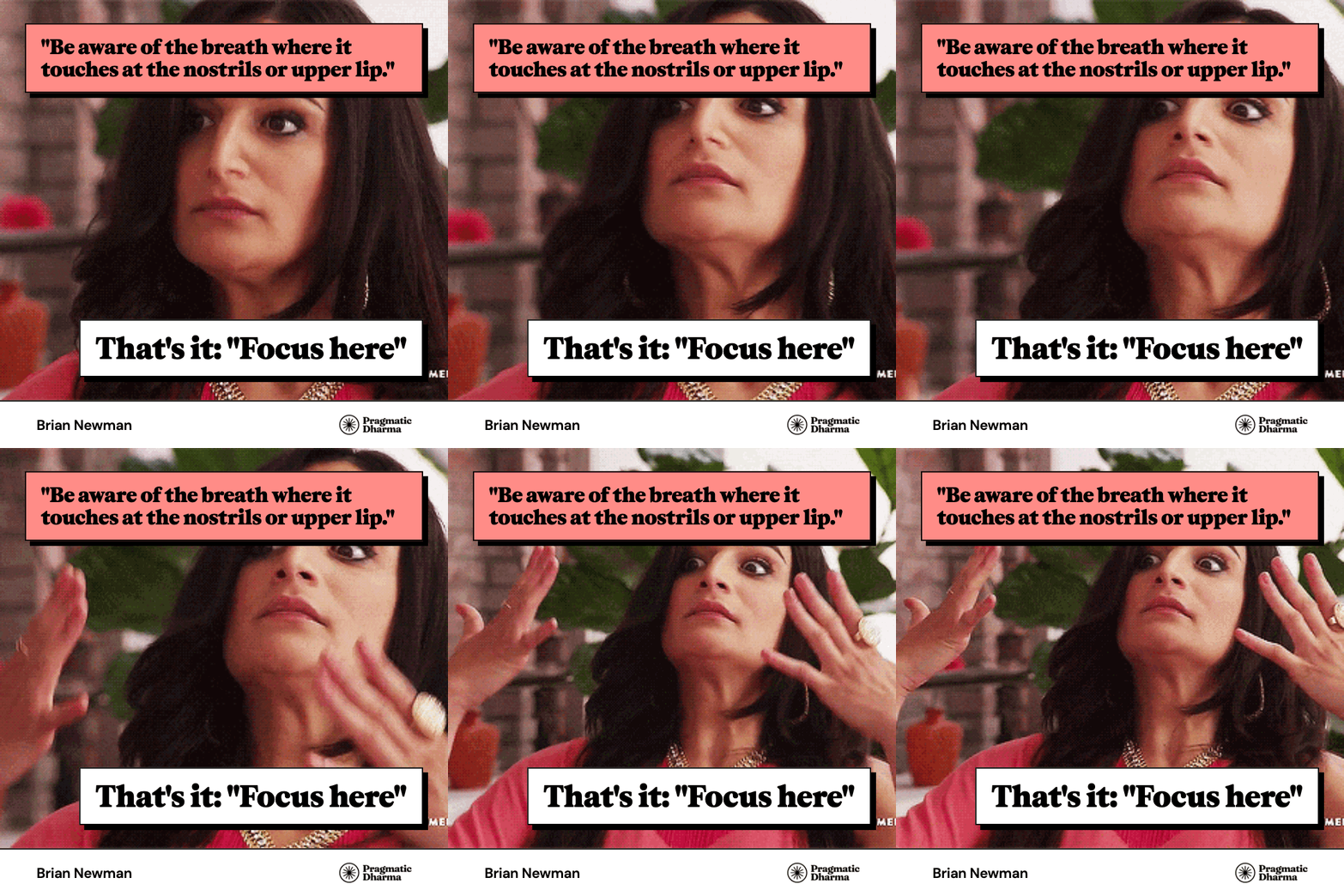
As this continues, the breath slows. The nervous system down-regulates. Pain reduces. Concentration increases. At some point, effort drops away and concentration feels almost effortless.
Access concentration arises. Hindrances recede. Sound fades. The object comes forward.
Then the jhāna factors arise: vitakka, vicāra, piti.
Vitakka is applied attention—trying to stay with the object. Vicāra is sustained attention—staying with it. Then piti arises: joy, rapture, goosebumps, energetic pleasure.
It can be intense. Sometimes overwhelming. If it is, you ground yourself.
Eventually piti fades, sukha arises, and the mind naturally moves on.
This is the arc of the practice: desire, attainment, dissatisfaction, movement.
The instruction never changes: “Focus here.”
May your vitakka and vicāra stabilize.
May you experience great joy and rapture on this retreat.


